
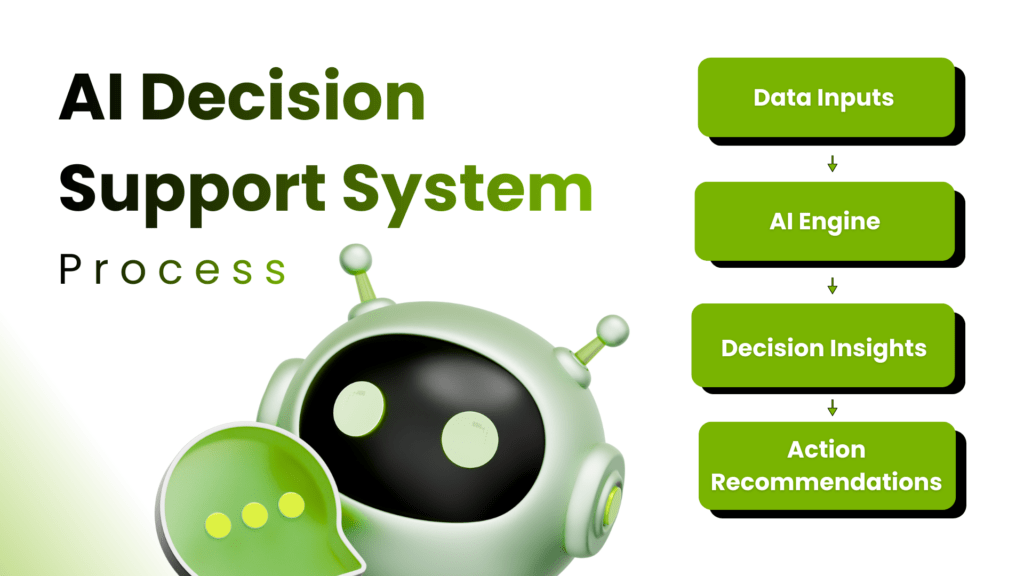
But what exactly is a decision support system? Simply put, it’s a set of tools and frameworks that help managers analyze data and make smarter decisions. Layer AI on top, and an AI decision support system becomes not just reactive, but anticipatory, adaptive, and ready to drive action.
Below are eight practical ways AI decision support systems are elevating strategic planning – plus current trends you should watch.
1. Faster, higher-quality scenario simulation
Traditional scenario work uses static assumptions. Modern AI-powered simulators run thousands of permutations in minutes, testing supply shocks, pricing moves, or regulatory shifts. A robust decision support system model now incorporates probabilistic forecasting and reinforcement learning to produce scenarios that reveal not only what could happen, but what leaders should prioritize.
Trend: Digital twins and synthetic data let firms simulate rare events without risking real assets.
2. Real-time situational awareness
Strategic decisions need current inputs. AI ingests streaming data – sales, social signals, sensor feeds – to update strategic dashboards continuously. This turns a decision information system from a monthly report into a living command center that alerts leaders to pivot points as they emerge.
Direction: Edge analytics and event-driven architectures reduce latency for mission-critical choices.
3. Data-driven prioritization of investments
Not all initiatives deserve equal funding. A data driven decision support system evaluates ROI, risk, and strategic fit across the portfolio and ranks projects objectively. This reduces bias and ensures resource allocation aligns with long-term goals.
Pattern: Causal inference methods are replacing simple correlations to estimate true impact.
4. Improved risk identification and mitigation
AI excels at pattern detection – spotting weak signals that humans miss. Incorporating an information and decision support system for risk management helps organizations surface supply chain fragilities, market micro-shifts, or emerging cyber threats before they become crises.
Evolution: Hybrid human-AI teams where AI flags risks and experts validate response plans.
5. Personalized strategy recommendations for business units
Large organizations need tailored strategies by region, product line, or channel. Decision support systems for business intelligence can generate unit-specific recommendations based on local data, enabling decentralized yet aligned strategic action.
Trajectory: Federated learning and privacy-preserving analytics let teams learn from shared models without exposing raw data.
6. Faster iteration through explainable insights
AI without transparency breeds mistrust. Modern AI decision support system implementations emphasize explainability – showing which inputs drove a recommendation and the confidence level. That enables leaders to accept, refine, or reject model outputs with accountability.
Shift: Explainable AI (XAI) tools and model cards are becoming standard for governance.
7. Automating repetitive strategy ops
Many strategy tasks-performance tracking, KPI reconciliation, scenario updates-are routine yet time-consuming. A decision assisting information system automates these workflows, freeing strategists to focus on high-leverage thinking and stakeholder alignment.
Indicator: Low-code automation and AI copilots embed into collaboration tools to accelerate execution.
8. Continuous learning and strategy refinement
A strategic plan should evolve. Decision support system for planning now includes feedback loops where outcomes are fed back into models to improve future recommendations. This makes strategy a continuous learning cycle, not a once-a-year ritual.
Momentum: MLOps and model observability practices ensure models stay healthy and aligned with changing conditions.
Final thought
AI-powered decision support is no longer optional-it’s a strategic advantage. From real-time insights and risk mitigation to smarter investment planning and continuous learning, AI DSS empowers leaders to plan with clarity and confidence. Organizations that embed intelligent decision systems today will outpace competitors tomorrow through faster, data-backed actions.
To design, implement, and scale AI-driven strategic planning tailored to your business goals, partner with Digitraly where technology, insight, and execution come together to drive smarter decisions and sustainable growth.