
While some companies still rely on informal commitments, most now prefer a structured partnership agreement to define roles, revenue sharing, responsibilities, and expectations. A clear agreement reduces friction, strengthens accountability, and builds long-term stability.
Today, partnerships are more common than ever. A 2025 industry report found that 77% of companies now work with at least one technology partner, reflecting how essential collaboration has become for innovation, digital transformation and market competitiveness.
If you’re looking to build stronger, clearer, and more strategic partnerships, now is the perfect time to establish a framework that sets your business up for long-term success. Let’s explore how the right partnership can create that impact throughout this blog.
What Are Business Partnerships?
Business partnerships are essentially formal collaborations between two or more organizations that work for mutual benefit, which could be in the form of growth, profitability, market development, technology sharing, or enhancement of operational capability. Business partnerships can be at the brand, startup, supplier, distributor, or service provider levels.
Some businesses operate on the basis of a simple handshake commitment, but most avail themselves of a partnership contract or company partnership agreement in order to align roles, revenue sharing, responsibilities, and expectations. Well-crafted agreements assure long-term stability and reduce operational friction.
Types of Partnership Businesses
There are different types of partnership structures in terms of control, liability, and revenue sharing. Some of the most acknowledged forms of partnerships in business include the following:
1. General Partnership
In a general partnership, there is shared ownership and responsibility. The partners contribute their capital or skills, and the profits are divided equally unless otherwise specified in a partnership agreement contract.
2. Limited Partnership (LP)
In a limited partnership, one partner is in charge of the operations, while another provides financial investments with limited liability. LPs are common in finance and real estate partnership investments.
3. Limited Liability Partnership
An Limited Liability Partnership (LLP) agreement protects each partner from being held liable for the business debts created by another partner. This LLP model suits law firms, consulting firms, and tech startups.
4. Corporate Partnership
A corporate partnership entails a collaboration with established companies in order to leverage brand power, distribution capacity, or market reach. These types boost expansion and reputation at enterprise scale.
5. Strategic Partnership
Here, one organization just complements the weaknesses of the other. An example could be a logistics company collaborating with any e-commerce brand to fulfill worldwide deliveries.
6. Equity-Based Partnership
The partners receive ownership of the business in return for resources, talent, or funding. This approach is helpful when the intention of the startups is to form a partnership deal with experienced investors or companies.
7. Partnership through Projects
Temporary collaboration, especially formed for individual ventures such as technology builds, campaigns, manufacturing, or development.
8. Network Building Partnership
It is designed to expand the network of connections, increase the supply of talent and enhance brand awareness. This strengthens partners in business and creates channels for long-term growth.
8 Key Reasons Strong Partnerships Matter in Business
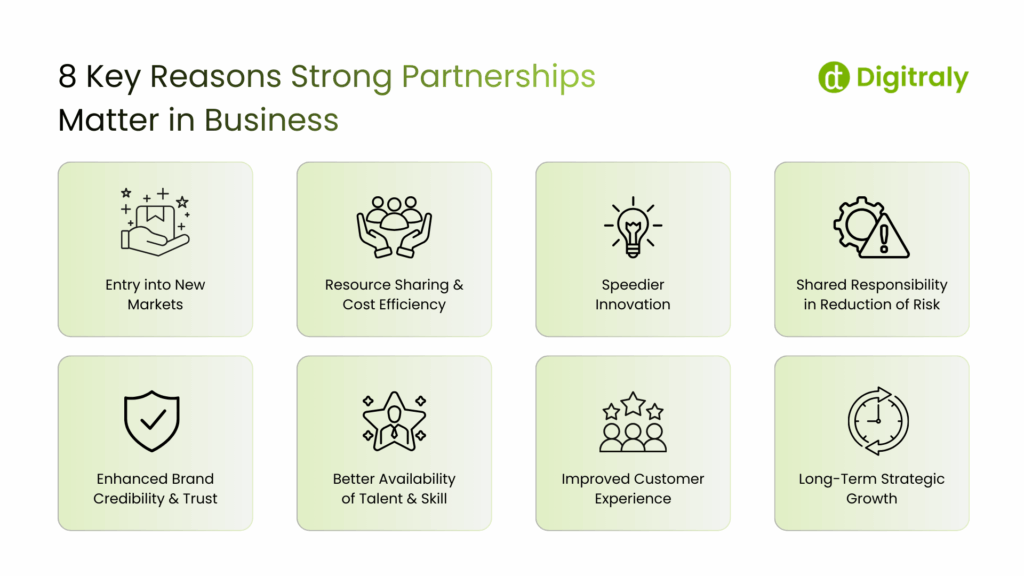
1. Entry into New Markets
It offers faster entry into new territories by businesses without developing infrastructure, logistics, or brand presence. Businesses leverage partners’ local connectivity and knowledge of the market rather than trying to understand and work through regulations, culture, or competition on their own. This reduces the expansion time, lowers the setup cost, increases acceptance in unfamiliar territories, and opens large customer pools with ease.
Advice: While selecting partners, always go for the ones that have a strong regional influence with a well-established customer base. This will make the process of market penetration quicker and far easier.
2. Resource Sharing and Cost Efficiency
The partnerships will drive a substantial reduction in capital spending and operational overheads through the sharing of certain operational resources, such as manpower, distribution, warehouses, and technology. Rather than buying everything, shared assets allow businesses to scale up much more quickly on the same budget. Financial risk is minimized, with productivity and profit margins maximized as both parties work efficiently with minimum duplication of investment.
Pointer: Make sure to clearly document the shared resources to avoid any type of conflict and for striking a balance in contributions appropriately.
3. Speedier Innovation
Collaboration brings a diverse way of thinking and cross-industry intelligence into one problem-solving ecosystem. That means ideas develop much faster, testing becomes efficient, and product cycles shrink dramatically. When, for example, a technology startup partners with a manufacturing entity, the cycle of innovation from concept to launch is moved forward in a far more rapid process, with each company thus able to leapfrog ahead in its respective industry while lessening research and development stress.
Cue: Joint brainstorming and innovation sprints can be held in order to maximize combined creativity and knowledge transfer.
4. Shared Responsibility in Reduction of Risk
In structures like limited partnership, general partnership, or limited liability partnership agreement (LLP), various types of risks—financial, legal, and operational—are shared rather than burdening one entity. Shared liability encourages bold decisions and experimentation, as no single partner is exposed to full loss. This type of partnership form acts like a safety shield during downturns, failures, or entry into new spaces.
Strategy: There should be clear lines of risk ownership and responsibility in the partnership agreement contract to prevent potential disputes.
5. Enhanced Brand Credibility and Trust
A tie-up with a renowned name instantly builds market confidence. Customers trust a brand more when it is supported or represented by reliable industry players. Even smaller enterprises build strong recognition through joint campaigns, co-branded offerings, or public endorsements. This results in better conversions, investor interest, and faster growth across regions.
Strategy: Utilize PR releases, social media, and cross-brand messaging to maximize value gained from a corporate partnership.
6. Better Availability of Talent and Skill
Instead of hiring new talent for every project, partnerships allow companies to share specialized expertise on demand. This eliminates complex recruitment cycles and reduces salary overhead. Through a strong company partnership agreement, businesses can access engineers, analysts, marketers, and consultants instantly speeding execution without compromising output quality.
Takeaway: Build a skill-sharing structure that lets partners exchange experts easily whenever specialized support is required.
7. Improved Customer Experience
When two companies combine their strengths such as one with product distribution and another with support or logistics customers enjoy faster delivery, fewer failures, and a better end-to-end experience. Such partners in business improve retention, generate brand loyalty, and drive long-term word-of-mouth growth. A well-designed business partnership contract can transform the entire customer journey.
Hint: Integrate customer service systems between partners for seamless coordination and quicker issue resolution.
8. Long-Term Strategic Growth
Partnerships compound over time opening new revenue channels, expanding networks, strengthening pros of collaborations, and enabling scale across multiple sectors. Whether it’s business partnership examples like tech & logistics or finance-driven real estate partnership, growth multiplies when goals align. With performance tracking and shared planning, businesses can scale sustainably without going solo.
Suggestion: Hold annual partnership evaluations to refine goals, add new opportunities, and strengthen your business partnership agreement for long-term success.
To Fold Up:
Strong partnerships are no longer optional—they’re essential. Whether you choose a general partnership, limited partnership, LLP, or corporate partnership, what matters most is structure, communication, and aligned vision. A well-drafted partnership agreement empowers businesses to scale faster, reduce risks, and operate with confidence. With collaboration, innovation thrives, markets open, and companies evolve beyond limitations.
If you’re preparing to form a partnership, ensure clarity, transparency, compliance, and measurable objectives stand at the core of your strategy. Great partnerships don’t just work—they build the future.
Ready to build a powerful partnership foundation?
Digitraly helps you design, structure and accelerate business collaborations with clarity, scale and strategic alignment. Let’s create partnerships that don’t just support growth but multiply it.