
Before approving any vendor, CTOs carefully examine whether the company can truly support the organization’s technical goals, security standards, scalability needs and long term business vision. If you are preparing to present a vendor for approval or wondering why proposals are delayed during the final stages, it is important to understand what CTOs genuinely look for before making a decision.
Why CTO Approval Is the Hardest Gate to Clear
By the time a vendor reaches the CTO’s desk, procurement and business teams have usually already approved the proposal. The focus then shifts from “Can they build it?” to “Can we trust them with our systems and long term goals?”
CTOs evaluate vendors based on technical compatibility, security standards, team collaboration and alignment with the company’s future roadmap. A poor web development vendor can create delays, technical debt, and long term operational risks.
That is why CTO approval processes are detailed, structured and often non negotiable.
1. Technical Credibility Beyond the Sales Pitch
A CTO’s first check is simple: does real engineering capability match what was promised in the sales conversation?
Stack Compatibility and Code Quality
Knowing frameworks like React or Node.js is expected. What matters more is whether engineers can:
- Design scalable systems
- Make sound architectural decisions
- Integrate with existing enterprise systems
- Avoid creating long term technical debt
- Write maintainable, production ready code
CTOs often request technical reviews or assessments before approving an enterprise web development engagement.
2. A Portfolio That Proves Enterprise Experience
At the CTO level, portfolio reviews are not about design or visuals. They are about proof that a vendor can handle real complexity in real environments.
A strong enterprise web development company does more than showcase finished products. It explains the full engineering story behind them, including:
- The constraints and limitations they started with
- The technical decisions that were made and why
- The alternatives that were considered and rejected
- How scalability, performance, and reliability issues were handled
- What the delivery process looked like, including handover and transition
- When case studies feel like engineering narratives instead of marketing content, CTOs take notice.
If a vendor cannot clearly describe the technical challenges behind their past work, it raises an immediate question: either they have not worked on truly complex systems or they are not being fully transparent about their experience.
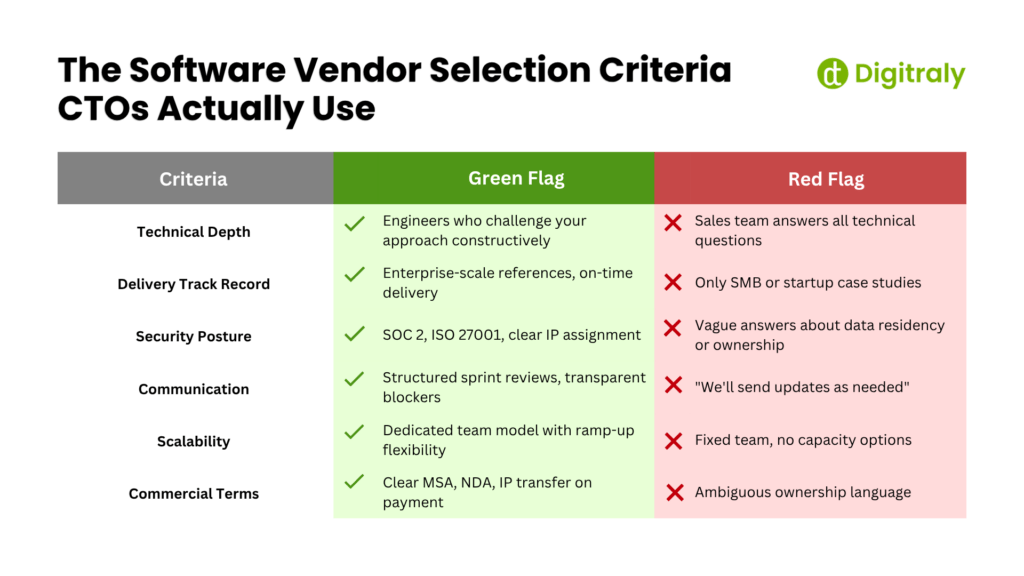
3. The Software Vendor Selection Criteria CTOs Actually Use
Most CTOs run a structured software vendor selection process, but their instinct fills the gaps that documentation can’t capture. Here’s how the core evaluation breaks down:
4. Agile Maturity and Communication Standards
Simply saying “we use Agile” carries little weight with a CTO. What matters is whether the vendor can demonstrate real, consistent delivery behavior.
CTOs look for clear evidence of how Agile is practiced in day to day work, such as:
- Sprint reviews that consistently produce demo ready outputs
- Documented retrospectives that show reflection and improvement
- A well structured backlog that reflects thoughtful prioritization beyond the current sprint
- Early identification and communication of risks, even when they are difficult to raise
During evaluation, CTOs often request artifacts like sprint reports or retrospective summaries. Vendors who can share these immediately build credibility and trust. However, when a vendor says they use Agile but cannot provide documentation or examples of how it is applied, it raises concerns about process maturity and transparency.
Ultimately, CTOs want a software development partner who can integrate smoothly into existing engineering practices, rather than a team that operates in isolation and requires constant external management.
5. Security, Compliance, and IP Protection
For a CTO, security is never a discussion point. It is a gate. If it is not clear, the vendor does not move forward.
Data Handling
CTOs expect precise, auditable answers to:
- Where data is hosted
- Who has access and how it is controlled
- How data is encrypted in transit and at rest
Anything vague or sales driven is treated as a risk signal.
Compliance Certifications
Common enterprise baselines include:
- SOC 2 Type II
- GDPR readiness
Lack of certifications is not just a gap. It signals maturity in security culture and governance.
IP Assignment
contracts.
- Full ownership of code and deliverables must transfer after payment
- No retained vendor rights unless explicitly stated
- Clear IP clauses must exist in legal agreements
If this is unclear, CTOs escalate to legal immediately.
6. Long-Term Fit as a Digital Transformation Partner
For a CTO, vendor selection is not just about delivering the current project. It is about whether the partner can scale with the organization over time. The real evaluation question is whether this vendor will still be valuable after the first release, when systems become more complex and expectations increase.
The difference shows early in scoping. Transactional vendors focus on closing quickly, while strategic partners raise deeper questions around technical debt, scalability, and long term ownership. Strong signals include phased delivery, structured knowledge transfer, solid documentation, and a clear model for ongoing support without restarting procurement every time.
Signals of a Strong Long Term Partner
- Phased delivery approach
- Knowledge transfer built into the delivery plan
- Strong documentation and onboarding support
- Clear post launch support and maintenance model
- Ability to work without repeated procurement cycles
- Alignment with internal engineering teams and processes
How CTOs Decide Which Web Development Vendors Get Approved
Vendors who consistently pass CTO approval are rarely chosen because they are the cheapest or even the most experienced. They are selected because they reduce uncertainty. They make technical, operational, and security decisions easier to trust by being clear about tradeoffs, consistent in delivery practices, and specific about how they have handled real engineering challenges in the past.
At the enterprise level, the web development partners are not just service providers. They function as an extension of the internal engineering team, collaborating closely during delivery and eventually enabling a smooth handover back to the organization without friction or loss of knowledge.
When vendors demonstrate this level of transparency, discipline, and long term thinking, the decision becomes less about risk management and more about confidence. And in most CTO evaluations, that is what ultimately drives approval.
How Digitraly Helps CTOs Make Faster and Safer Decisions
Strong web development partners help CTOs feel confident across three areas:
- Technical execution
- Operational reliability
- Security and long term maintainability
Digitraly works with CTOs by removing uncertainty across planning, execution and handover. It aligns early on architecture, security and scalability, then delivers through structured sprints with clear communication and risk visibility. Strong documentation and knowledge transfer ensure smooth transition to internal teams. The result is a predictable, low friction engineering partnership that fits enterprise CTO expectations.
If you want a web development partner that removes uncertainty instead of creating it, Digitraly is built for you. Let’s connect and turn your next build into a predictable, CTO ready delivery.