
According to IBM’s Cost of a Data Breach Report 2025, the average cost of a data breach reached $4.44 million globally. The organisations that contained breaches fastest were those with mature IAM security frameworks already in place before the incident occurred.
What Identity and Access Management Actually Means
Identity and access management is the set of policies, processes and technology that controls who can access which systems and what they can do once inside. It governs every digital identity in an organisation, from employees and contractors to applications, devices and automated processes.
The core function of an IAM system is to ensure the right entity has the right access to the right resource at the right time, and that access is recorded, auditable and revocable. This sounds operational. In practice it determines the security posture, compliance readiness and operational efficiency of the entire organisation.
IAM Solutions Typically Cover Four Capabilities
- Identity lifecycle management
- Authentication
- Authorisation
- Access governance
Each capability addresses a distinct failure mode that, left unmanaged, creates material risk to business continuity and data integrity.
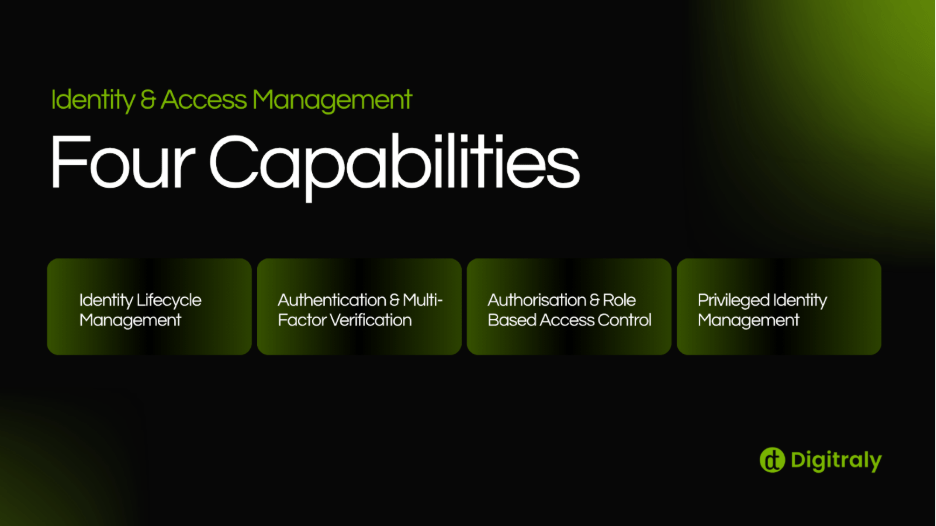
The Four Capabilities Every IAM Framework Covers
Identity Lifecycle Management
Every person or system that interacts with your infrastructure needs a digital identity. Identity management covers the full lifecycle of that identity: creation when someone joins, modification when their role changes and deprovisioning when they leave.
Organisations without automated identity management software routinely find former employees retaining active system access months after their departure.
Authentication and Multi-Factor Verification
Authentication confirms that the entity requesting access is who they claim to be. IAM cyber security practice has moved well beyond password-based authentication toward multi-factor and risk-adaptive models that evaluate the context of each access request.
Modern identity software evaluates signals including device health, location, time of access and behavioural patterns to assign a risk score to each authentication event. High-risk requests trigger additional verification. Low-risk requests from known devices in expected contexts proceed without friction. This approach reduces both security exposure and the user experience cost of security enforcement.
Authorisation and Role-Based Access Control
Authorisation determines what an authenticated identity is permitted to do. Identity governance and administration frameworks map permissions to roles rather than individuals, which means access changes with role changes and does not require manual audit of each individual’s permission set.
The principle of least privilege, central to every serious IAM security framework, holds that each identity should have the minimum access necessary to perform its function. Enforcing least privilege through role-based controls reduces the damage any single compromised account can inflict.
Privileged Identity Management
Privileged accounts such as system administrators, database operators and service accounts carry the highest level of access and represent the highest value target for attackers. Privileged identity management adds a dedicated security layer to these accounts through session recording, time-limited access grants and just-in-time provisioning.
Most breaches involved compromised privileged credentials. A dedicated privileged identity management solution addresses this specific and disproportionate risk.
Choosing the Right IAM Solutions for Your Organisation
Regulators across industries now mandate controls that identity governance frameworks are designed to satisfy. GDPR requires demonstrable control over who accesses personal data and the ability to audit that access. SOC 2 requires access controls and user access reviews as part of the trust service criteria. ISO 27001 mandates access management policies as part of information security governance.
- Identity governance and administration tools automate the access certification process, in which managers periodically review and confirm whether their team members’ access rights remain appropriate.
- Without automation, access certifications are completed manually, infrequently and inconsistently, which creates both compliance gaps and practical security exposure.
Identity governance also supports separation of duties enforcement, ensuring that no single identity can both initiate and approve a sensitive transaction. In financial and healthcare environments this control is not a recommendation. It is a regulatory requirement.
Build an IAM Framework That Matches Your Risk Profile
At Digitraly, we work with technology businesses and enterprise teams to design and implement identity and access management architectures that are proportionate to their environment, compliant with their obligations and operationally practical for their team.
Whether you are establishing a foundational IAM system for a growing SaaS product, expanding cloud IAM controls across a multi-cloud environment or implementing a privileged identity management layer for an enterprise infrastructure, we bring the technical and strategic depth to do it right the first time.
Ready to build an identity security foundation your business can scale on?
Get in touch with the Digitraly team and let us show you what a properly designed identity and access management framework looks like for your organisation.