The problem is not visibility. The problem is action.
Most healthcare dashboards are designed to answer one question: What happened? Very few are designed to answer the questions that truly matter to decision-makers: Why did it happen? What is the impact? What should we do next?
As healthcare organizations continue investing in healthcare analytics, healthcare business intelligence, and digital transformation initiatives, expectations are changing. Leaders no longer want dashboards that simply display information. They want systems that help teams move from information to action.
Healthcare Teams Are Drowning in Information
Modern healthcare dashboards provide access to an enormous amount of information. A hospital operations manager can view patient wait times, emergency department performance, discharge rates, staffing levels, and bed occupancy from a single screen. Finance teams can monitor billing performance, claims processing, and revenue cycle metrics in real time.
While this visibility is valuable, it often creates a new challenge. Teams are expected to interpret large volumes of information before they can make a decision.
For example, a dashboard may reveal that emergency room wait times have increased by 18 percent over the last week. The information is useful, but it does not explain why the increase occurred.
Was it caused by staffing shortages?
- Delayed admissions?
- Diagnostic bottlenecks?
- Bed availability constraints?
The dashboard identifies the problem, but healthcare professionals still need to perform the investigation.
Dashboards Were Built for Reporting, Not Decisions
One of the most common reasons healthcare dashboards fail to drive decisions is the lack of context.Most healthcare KPI dashboards tell users what happened. Few explain why it happened.
Consider patient discharge delays. A dashboard may show that discharge times are increasing. However, without context, teams cannot determine whether the problem originates from staffing limitations, delays in physician sign-offs, transportation issues, or bed management inefficiencies.
The same challenge exists across healthcare operations. Metrics alone rarely tell the full story.
This is where many healthcare analytics initiatives lose momentum. Teams spend so much time searching for explanations that they have less time available to solve problems.
The Hidden Cost of Dashboard Fatigue
Healthcare professionals often work under significant time pressure. When dashboards contain excessive charts, reports, and performance indicators, users can experience what is commonly known as dashboard fatigue.
Dashboard fatigue occurs when users are overwhelmed by information and struggle to identify what deserves attention.
Over time, this creates several problems:
• Slower decision-making
• Reduced dashboard adoption
• Lower trust in analytics systems
• Increased dependence on manual reporting
Ironically, organizations that invest heavily in healthcare data visualization can still struggle to achieve meaningful business outcomes if dashboards become too complex.
Healthcare Teams Need Guidance, Not Just Data
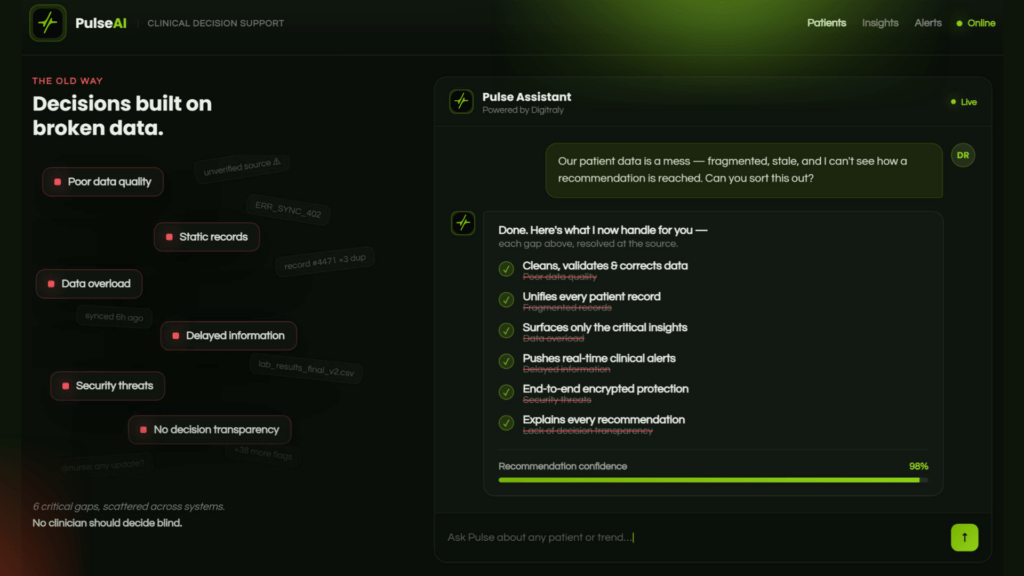
Modern healthcare environments require more than reporting. They require guidance.
This is why healthcare organizations are increasingly exploring healthcare operational intelligence, healthcare decision support systems, and AI-assisted analytics.
The objective is not to replace healthcare professionals. The objective is to help them make better decisions faster.
Advanced systems can identify unusual patterns, detect risks early, surface actionable insights, and prioritize issues that require immediate attention. Instead of forcing users to analyze dozens of reports, these systems help teams focus on what matters most.
This shift is driving growing interest in AI-powered decision support systems that can combine operational data, contextual insights and intelligent recommendations within a single workflow. By helping teams understand not just what is happening, but why it is happening and what actions should follow, these solutions are making healthcare decision-making faster and more effective.
The Shift Toward Decision Intelligence
Healthcare analytics is evolving beyond traditional reporting.
Organizations are increasingly moving toward decision intelligence, a model that combines analytics, operational context, predictive insights, and actionable recommendations.
Instead of simply displaying information, modern platforms help users understand risks, identify bottlenecks, and prioritize actions.
Decision intelligence is not just about improving analytics. It requires organizations to connect people, processes, and technology so that insights can move seamlessly into action. For many healthcare providers, this is becoming an important objective of their broader digital transformation journey.
The Future of Healthcare Analytics
The future of healthcare analytics is not about collecting more information. Most organizations already have access to more data than they can effectively use.
The future lies in delivering the right insight at the right time with enough context to support confident decisions.
As healthcare business intelligence, healthcare operational intelligence, and AI-assisted analytics continue to mature, organizations will increasingly prioritize platforms that help teams move from visibility to action.
Healthcare organizations do not need more dashboards. They need systems that help people understand problems faster, collaborate more effectively, and make better decisions.
Conclusion
Healthcare dashboards have transformed visibility across healthcare organizations. However, visibility alone does not guarantee better decisions.
Organizations that focus on contextual insights, operational intelligence, and decision support will be better positioned to improve efficiency, collaboration, and patient outcomes. The future belongs to platforms that help teams move confidently from information to action.
Discover how your organization can turn healthcare data into measurable outcomes.
Book a free demo and explore decision intelligence in action.